Tabla de contenido
The digital world is moving at a dizzying speed. What worked in 2023 today may be obsolete, and what is trending today, in 2026 will be standard. In this context, understand what the Web Marketing And how to use it to increase sales is not just a competitive advantage: it is a matter of business survival.
In this article, we will explore in depth web marketing, its differences with digital marketing, why it is fundamental for your business and, most importantly, the most effective strategies for 2026. We will also see key tools, essential metrics and future trends that will transform the way we interact with the online customers.
What is web marketing?
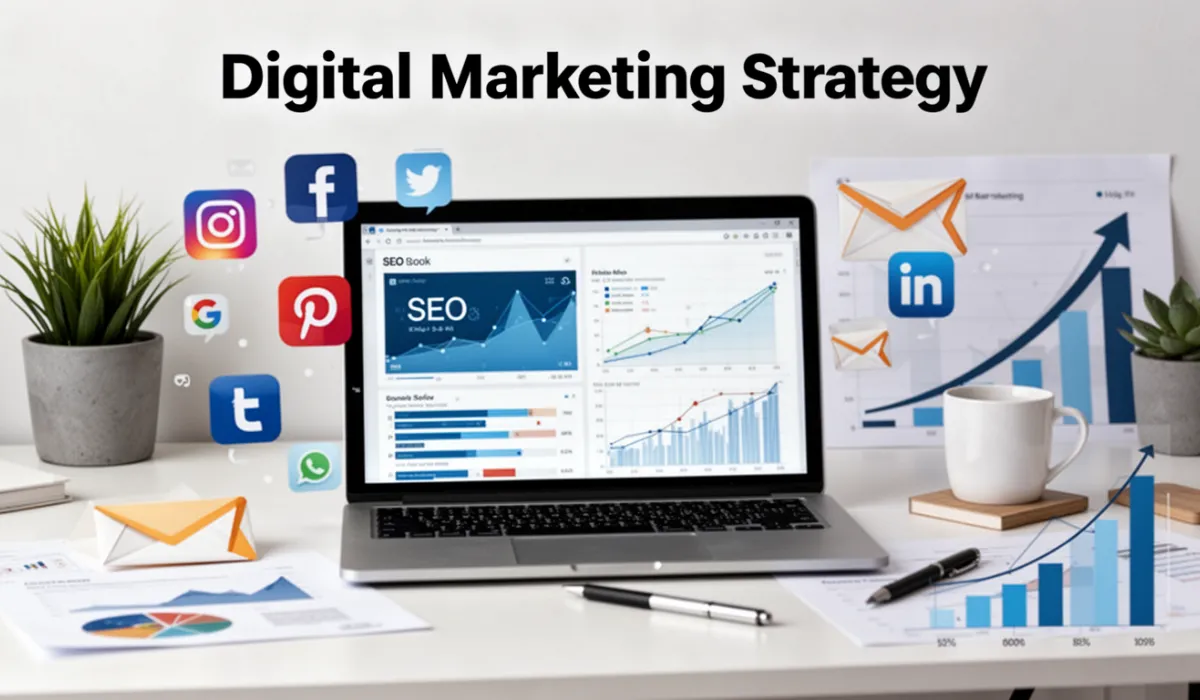
The Web Marketing It is the set of strategies Digital Marketing Specifically focused on a website as the central axis, with the aim of attracting qualified traffic, converting it into leads or sales, and retaining it using the different online channels. It is, in essence, the art of making your website the best seller of your business.
When we talk about Web Marketing, we refer to all the actions that have your website as your final destination: from when a user clicks on an organic search result until it arrives through an ad on social networks or a link in a newsletter. The website Act like the Operations Center, the ‘digital showcase’ that works 24/7, 365 days a year, generating sales opportunities even while you sleep.
Difference Between Web Marketing and Digital Marketing
It is common to confuse both terms, but there is a fundamental difference:
- Digital Marketing: is the umbrella that includes all Digital channels: mobile applications, digital television, video games, advertising on streaming platforms, etc. .
- Web Marketing: It is a subset of Digital Marketing that focuses on strategies that have the web as their ultimate goal: SEO, SEM, content marketing, email marketing, among others.
In other words, all web marketing is digital marketing, but not all digital marketing is web marketing. An advertisement in a mobile app that does not direct to a web is not part of web marketing, while an article in a blog that seeks to position your site does.
Why is web marketing essential for companies?
In competitive markets such as the United States, Spain or Mexico, having an online presence is no longer enough. The question is not if you are on the internet, but how You stand out from the crowd. These are the reasons why web marketing is essential today:
1. Increased visibility in search engines
Google processes more than 8.5 billion searches a day. If your website does not appear among the first results, you simply do not exist for most users. 75% of clicks are concentrated on the first five results.
2. Generation of qualified leads
The Web Marketing Well executed attracts people who They are already looking What you offer. Don’t interrupt your experience with intrusive advertising; You appear when they need you. This generates higher quality leads with a higher probability of conversion.
3. Improved brand positioning
A consistent, quality online presence builds authority and trust. When users see your brand repeatedly in searches, social networks and valuable items, they begin to perceive you as a benchmark in your sector.
4. Increase in sales and conversions
the final goal. a strategy of Web Marketing Well orchestrated not only attracts visitors, but also guides the user through the purchase journey: from discovering your brand to becoming a customer and finally, ambassador for it.
5. Availability 24/7
Unlike a physical store, your website never closes. You can be attracting customers and generating income at any time, anywhere in the world, at no additional cost for extended hours.
Main Web Marketing Strategies
By 2026, the strategies of Web Marketing They have evolved. It is no longer enough to apply isolated techniques; An integrated approach is required where each channel feeds back. Let’s analyze the most important ones.
SEO (Search Engine Optimization)
The SEO It remains the backbone of sustainable web marketing. In 2026, Google has refined its algorithms to reward quality, relevance and, above all, search intention .
SEO on page
It’s not just about including keywords in the right places anymore. The modern SEO on page focuses on:
- Content that satisfies search intention: Google knows if the user wanted to buy, inform or compare. Your content should perfectly align with that intention.
- Header Structure (H1, H2, H3): Facilitates reading for both users and robots.
- Image optimization: With descriptive ALT tags and lightweight formats (webp) that do not slow down the load.
- internal bonding: Help distribute authority among your pages and guide the user towards conversion.
technical seo
Technical aspects are the basis on which everything else is built:
- loading speed (Core Web Vitals): Google penalizes slow webs. A second delay can reduce conversions by 7%.
- Responsive design: 70% of web traffic comes from mobile devices. Your website should be viewed and function perfectly on any screen.
- Site architecture: A logical and clear structure makes it easy to track search engines and user navigation.
Link Building
Links remain one of the most influential ranking factors. Google’s first position pages have 3.5 times more backlinks than the second page. But in 2026, the quality is inversely proportional to the quantity. A Forbes link (Dr 96) is worth more than 50 low-quality blog links.
Link Building Strategies for 2026:
- digital pr: 67.3% of Link Building professionals use digital public relations as the main strategy. Creating news content (original studies, exclusive surveys, trend reports) attracts media links naturally.
- Broken Link Building: Find broken links on websites in your sector and offer your content as a substitute. It’s a win-win technique.
- Strategic Guest Posting: It is not about publishing on any site, but on blogs and media in your sector with authority, contributing real value content.
- Linkable Assets: Create such valuable resources (definitive guides, calculators, free tools, infographics) that other sites want to link them naturally.
- co-citation links: Appear in the same lists and mentions as your competitors, which helps Google understand you as a relevant entity in your sector.
Correctly implementing these techniques requires not only knowledge, but also strategic planning and impeccable technical execution that adapts to the constant updates of the algorithms. For this reason, many companies opt for the support of specialists. Agencies like Rankuba Seo They are dedicated to optimizing websites in a comprehensive way, focusing on improving organic positioning with sustainable and ethical techniques to attract highly qualified traffic that really becomes customers.
SEM and advertising in Google Ads
If he SEO It’s a marathon, the SEM is a sprint. Paid advertising allows you to appear in the first results immediately. But in 2026, the SEM has changed radically.
How PPC works in 2026
Google Ads It is now much more automated. Performance Max and Demand Gen campaigns use artificial intelligence to optimize bids, segmentation, and real-time creatives. Success no longer depends on both manual optimization and signal quality that you provide to the algorithm.
The ‘3 Cs’ of the modern SEM
- Conversion Tracking: If you do not measure correctly, the algorithm cannot optimize. Make sure that Google Ads Record each purchase or microconversion.
- Consent Mode V2: With the growing privacy regulations, correctly implementing the consent mode is crucial to not undervaluing your conversions.
- Customer Match: First-hand data (existing customers) is the most powerful signal. Use them to create similar audiences (looklike).
When to use paid ads
- Throws: To publicize a new product or service quickly.
- high competition: In saturated niches where the SEO organic takes months.
- seasonality: For Black Friday, Christmas or specific events.
- Remarketing: To recover users who visited your website but did not buy.
Key differences in 2026
- Keywords vs. signals: Keywords alone are no longer enough. Product feeds, structured data, and web content help platforms understand what you are and when to show you.
- YouTube mandatory: It is no longer optional. Short and low production videos can have a huge impact on Discovery and purchase intention.
Content marketing
Content is the fuel of web marketing. But not any content is worth it; In the age of saturation of information generated by AI, the differential value will be the professional and cultural criteria .
Strategic Blogging
A BLOG It is not a personal diary, it is an attraction tool. Each article should answer a real question from your audience and guide it one step closer to the conversion.
Evergreen Content
It is the content that remains relevant month after month, year after year. Definitive guides, basic tutorials, frequently asked questions… This type of content generates constant traffic and builds long-term authority.
conversion funnels
The content must be adapted to each stage of the consumer journey:
- Tofu (Top of Funnel): Content to attract (informative articles, basic guides).
- Mofu (Middle of Funnel): Content to convert (ebooks, webinars, case studies).
- Bofu (Bottom of Funnel): Content to close (comparatives, testimonials, demonstrations).
Email Marketing
Far from dying, email marketing continues to be the channel with the highest return on investment (ROI). For each euro invested, the average return is €36.
Automation
Automatic workflows allow you to send the right message at the right time:
- Welcome: For new subscribers.
- abandoned cart: To recover sales.
- post-purchase: To retain and sell accessories.
Segmentation
Not all customers are the same. Segment by behavior, interests, purchase history… and customize each message. The Hyperpersonalization It is the key for 2026.
lead nurturing
It’s about ‘educating’ the lead until you’re ready to buy. Send valuable content that solves your doubts and shows you why your solution is the best.
Social Media Marketing
Social networks have evolved from being a mere showcase to becoming direct sales channels (Social Commerce).
Organic Strategy
- Community building: Answer comments, generate conversation, humanize the brand.
- value content: Not everything is sale. Share tips, entertainment, stories.
- active listening: Networks are an inexhaustible source of insights about your audience.
Advertising in Social Media
- Precise segmentation: You can reach users by age, interests, behaviors and even job positions.
- Native formats: Ads that are naturally integrated into the feed, stories or reels.
- Social Commerce: Platforms like Instagram Shopping or TikTok Shop allow you to purchase without leaving the app.
According to Hubspot, the 64% of Gen Z users They claim to have discovered a new product on social networks in the last 3 months.
Key tools to implement web marketing
No modern strategy can be executed without the right tools. Here are the most important ones:
| Category | Gear | main function |
|---|---|---|
| SEO | SEMRUSH, , ahrefs, sistrix, seo spyglass | Keyword research, backlink analysis, technical audits. |
| analytics and metrics | Google Analytics 4, , Google Search Console | Traffic tracking, user behavior, search engine performance. |
| Marketing Automation | Hubspot, Marketo, ActiveCampaign | Automated Email Marketing, Lead Scoring, Nurturing, Workflows. |
| CRM | Salesforce, Hubspot CRM, Zoho | Centralized management of clients and leads, tracking of interactions. |
| Monitoring of mentions | Google Alerts, Brand24, Mention | Detect mentions of your brand to turn them into backlinks. |
How to create a step-by-step web marketing strategy
A solid strategy is not improvised. Follow these steps to build yours:
1. Define clear objectives (Smart)
- specific: ‘Increasing sales’ is not valid. ‘Increase Product Sales X by 20%’ Yes.
- measurable: Set clear KPIs.
- achievable: Be realistic with your resources.
- relevant: What do they import for your business?
- with defined time: ‘In the next 6 months’.
2. Analyze market and competition
- Define your buyer person: Who are you going to? What problems do you have? Where does time spend online? .
- Study competitors: What channels do you use? What keywords work for them? What gaps can you take advantage of? .
3. Optimize the website
- User Experience (UX): Intuitive navigation, fast loading times, responsive design.
- Search Engine Optimization: Apply the bases of the SEO technical and on-page .
4. Create strategic content
- Editorial Calendar: Plan in advance.
- Content for each stage of the funnel: Attract, educate, convert.
- various formats: Articles, videos, infographics, podcasts.
5. Continuously measure, analyze and optimize
The Web Marketing It’s not static. Review your metrics, identify what works and what doesn’t, and adjust your strategy. Continuous improvement is the key to long-term success.
Metrics and KPIs in Web Marketing
It is not enough to have data; You have to know how to interpret them. Here are the essential metrics you should monitor:
- organic traffic: Visits that come from search engines. Indicate the health of your SEO.
- conversion rate: Percentage of visitors performing the desired action (purchase, registration, download).
- Cost per acquisition (CPA): How much you invest on average to get a new customer.
- Return on Investment (ROI): (Income – Investment) / Investment. The metric reigns.
- Customer Acquisition Cost (CAC): Total investment in marketing / Number of new clients.
- Customer Lifetime Value (LTV): Total benefit generated by a client during his entire relationship with the company. Ideally, LTV should be > 3x CAC .
- rebound rate: Percentage of users who enter and leave without interacting. A high rate can indicate content or usability issues.
When to hire a web marketing agency?
There comes a time when doing everything internally ceases to be viable or efficient. These are signs that you need professional help:
- Lack of sustainable results: Your traffic does not grow, or grows but does not convert.
- Excessive dependency on paid advertising: If you disconnect the ads, the sales stop.
- Lack of time or technical knowledge: the SEO and SEM require constant updating.
- Stagnation: You’ve reached a roof and you don’t know how to get over it.
If your business depends almost entirely on paid advertising to generate income, or if you have tried to improve your organic positioning without seeing sustainable results over time, it is a clear sign that you need an expert vision. Working with professionals gives you a personalized strategy, saves you learning curves and maximizes your return on investment. In this context, Rankuba Seo It offers just that: tailor-made strategies focused on long-term organic growth, advanced technical optimization and conversion rate optimization so that your business not only has visitors, but also increases its sales consistently.
Conclusion: The Future of Web Marketing
The Web Marketing In 2026 and beyond it is defined by three major trends:
1. Artificial intelligence and automation
AI is not the future, it is the present. From content creation to campaign optimization, AI is transforming all facets of the Web Marketing. But attention: technology is a tool, not a substitute for human criteria.
2. Generative Engine Optimization (GEO)
Just as we optimized for Google, in 2026 we began to optimize for AI assistants (ChatGPT, Gemini, Perplexity). The GEO seeks that your brand be cited as a reliable source in the answers generated by AI. Appearing in these answers will be as important as appearing on the first page of Google.
3. The economy of the ‘little whim’ (Treatonomics)
In times of uncertainty, consumers are looking for affordable small rewards. Marketing strategies should appeal to this immediate gratification, to those little luxuries or whims that improve the day to day.
4. The human factor as a differential
In a world-saturated content created by machines, authenticity, cultural sensitivity and genuine human connection will be the most valuable asset. The brands that tell real stories, with their own voice and clear values, will be the ones that really connect with their audience.
The Web Marketing It’s a journey, not a destination. The strategies that work for you today, you will have to adjust them tomorrow. The key is to stay informed, be agile and, above all, never lose sight of the person on the other side of the screen.
Are you ready to take your business to the next level in 2026? Start today to build a strategy of Web Marketing Solid, sustainable and customer-centric. And remember: you don’t have to do it alone.