Tabla de contenido
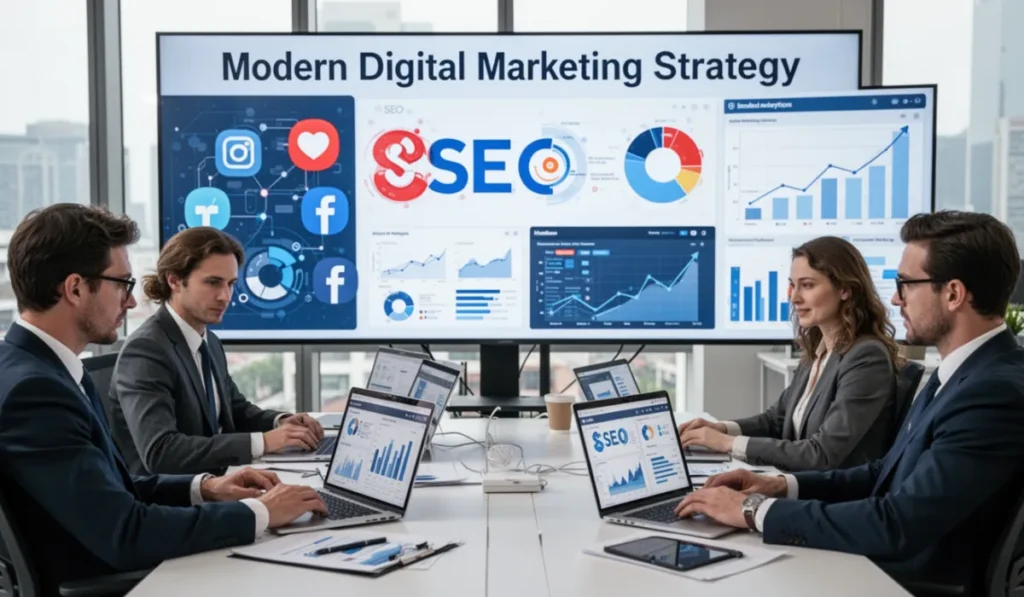
In today’s world, your customers are online. They are moving around social networks, searching for solutions on Google and checking their email at any time. To get to them effectively, you can’t rely on intuition or sporadic posts. You need a plan. You need strategies of Digital Marketing.
This complete guide will explain everything you need to know about the strategies of Digital Marketing. We will address what they are, why they are essential, the different types that you can use and how to build yours step by step to boost real growth in your business.
What are digital marketing strategies
A digital marketing strategy It is an action plan that describes how a business will use online channels to achieve specific marketing and business goals. It is the general roadmap that guides all your digital efforts, from your website and social media posts to your email campaigns and paid ads. Think of it as the ‘master plan’ that ensures that every action you perform online has a purpose and works towards a common goal.
Difference Between Strategy and Digital Marketing Tactics
This is one of the most important distinctions that we must understand. Although often used interchangeably, a strategy and one tactic They are two very different things.
- The strategy It is the ‘what’ and the ‘why’. It is the overall plan based on your goals. It is your diagnosis of the market and your guiding policy for success.
- The tactic It’s the ‘how’. They are the specific and actionable steps you take to execute your strategy.
For example:
- Strategy: Increase organic traffic to our website by 25% in the next six months to generate more leads.
- Tactics: Post two Blog articles Optimized for SEO per week; Get backlinks through guest posts on industry sites; Update 10 old blog articles with new data and keywords.
Without a strategy, your tactics are just random acts of marketing. Without tactics, your strategy is just an illusion.
Objectives that can be achieved with a digital strategy
A well-defined digital strategy can help you achieve a wide variety of goals:
- Increase brand awareness: Make your brand known to a broader audience.
- Generate more leads (leads): Capture contact information from potential customers.
- Increase sales (online and offline): Drive income through your online or physical store.
- Improve customer loyalty: Build stronger relationships and turn customers into brand advocates.
- Establish thought leadership: Position your company as an expert in your industry.
Why Digital Marketing Strategies Are Important
In an era where the average person spends more than six hours a day online, a solid digital presence is not optional, it is essential. A coherent strategy provides the framework for that presence to be effective.
Key benefits for companies and entrepreneurs
- Measurable results (ROI): Unlike a billboard or a TV ad, digital marketing allows you to track almost everything. You can see exactly how many people viewed your ad, clicked on it and became customers, allowing you to accurately calculate your return on investment (ROI) .
- Precise audience segmentation: Digital platforms allow you to target your ideal client based on demographic data, interests, location, online behavior and more. This ensures that your marketing budget is spent on reaching people more likely to buy you.
- Profitability: Digital marketing levels the playing field. Small businesses can compete with large corporations using profitable strategies like SEO, Content marketing and social-segmented ads, which often have a lower cost and a greater impact than traditional advertising.
- Improved customer interaction: Digital channels allow bidirectional communication. You can interact with your audience, answer their questions, and build a community around your brand, fostering stronger, more loyal relationships.
- Flexibility and agility: If a campaign is not working well, you can adjust it in real time. This agility is a massive advantage over traditional marketing, where changes are expensive and slow.
Advantages over traditional marketing
| Factor | Traditional marketing | Digital Marketing |
|---|---|---|
| Cost | High (production and placement) | Low to medium (scalable) |
| Segmentation | Wide (demographic) | Highly specific (behavior, interest) |
| Measurement | Difficult (estimates) | Accurate (real-time data, ROI) |
| Interaction | one-way (diffusion) | Bidirectional (conversation, commitment) |
| Flexibility | Low (difficult to change) | High (continuous optimization) |
How they help generate customers and sales
the strategies of Digital Marketing They work by guiding potential customers through a journey, often called the Marketing funnel. You attract strangers with valuable content (top of the funnel), nourish them to turn them into leads with specific information (middle middle part) and transform them into satisfied customers with persuasive offers and a smooth shopping experience (bottom of the funnel). This systematic approach builds trust and leads people from being merely interested to becoming paying customers.
How to create a step-by-step digital marketing strategy
Creating an effective strategy may seem daunting, but by dividing it into manageable steps, you can build a powerful plan. A popular framework is the Sostac® model, which guides you from your current situation to control and improvement. Here are the essential steps:

1. Define SMART Objectives
Start with the end in mind. What do you want to achieve? Your goals should be SMART :
- s (specific – specific): clear and well defined. (Ex: ‘Increase email subscribers’).
- m (measurable – measurable): You can follow the progress. (Ex: ‘…in 20%’).
- To (Achievable – Achievable): Realistic with the resources you have.
- R (Relevant – Relevant): Aligned with the general objectives of your business.
- t (with defined deadline – time-bound): It has a deadline. (Ex: ‘…in the next quarter’).
2. Identify your buyer person or target audience
You can’t go to everyone. A buyer person It is a semi-fictional representation of your ideal client based on market research and real data from your existing customers. Includes demographic data, behavior patterns, motivations and goals. understand their weak points—The problems that your product or service solves — is crucial to creating content that resonates with them.
3. Analyze competition and the market
Before you go, understand where you are. Do a review of:
- Your internal assets: What is working on your website, blog and social networks? What are your shortcomings? .
- Your competition: What are your competitors online doing? What channels do they use? What can you do differently or better? .
- THE MARKET: What are the current trends and opportunities? A SWOT analysis (weaknesses, threats, strengths and opportunities) is an excellent tool for this stage.
4. Choose the right digital channels
based on your person And in your analysis, select the channels where your audience spends their time. Do not try to be everywhere at once. It is better to dominate one or two channels than to have a weak presence in five. Options include your website, organic social networks, email, and paid advertising.
5. Create a content plan
The content is what you will use to attract and engage your audience on the chosen channels. Your content plan should detail:
- Keywords and topics: What questions does your audience ask? What terms are you looking for? Focus on your weak points.
- Content formats: Will you create blog posts, videos, infographics, podcasts or case studies? Choose the format that best tells your story and suits your audience.
- Content Calendar: Plan when and where you will post your content to stay organized and consistent.
6. Define budget and tools
Determine how much you can invest in paid advertising, software tools (such as email marketing platforms, analytics tools, or design software), and potentially freelancers or agencies. There are excellent free and low-cost tools for almost every aspect of digital marketing.
The most effective digital marketing strategies
There are many types of strategies of Digital Marketing, and the best approach often combines several of them. Here are some of the most effective you should consider:

1. SEO (Search Engine Optimization)
The SEO It is the process of optimizing your website and its content to appear in the first positions of the results of search engines such as Google. With more than 75,000 Google searches every second, appearing on the first page can generate a huge amount of free (organic) traffic to your site. It involves keyword research, page optimization, and link building (backlinks).
2. Content marketing
This strategy focuses on creating and distributing valuable, relevant and consistent content to attract and retain a clearly defined audience. The objective is not to promote your products directly, but to provide useful information that generates trust and authority, finally promoting profitable customer action. This may include blog posts, videos, e-books, and infographics.
3. Social Media Marketing (Social Media Marketing)
SMM uses social media platforms like Instagram, LinkedIn, Facebook and TikTok to connect with your audience, build your brand, and direct traffic to your website. It’s not just about publishing; It’s all about participating in conversations, building a community, and even offering customer service. For example, 61% of Instagram users have used the platform to discover new products.
4. Email Marketing
The Email Marketing It remains one of the most effective channels in terms of ROI. It consists of sending segmented emails to a list of subscribers to nurture leads, promote content or products and retain customers. Automated email sequences can welcome new subscribers, retrieve abandoned shopping carts, or re-engage idle customers.
5. Digital advertising (SEM and PPC)
The PPC (Pay per Click) is an Internet marketing model in which advertisers pay a fee every time one of their ads is clicked. It is a way to ‘buy’ visits to your site instead of earning them organically. Google Ads (for search) and ads on social networks are the most common ways. The PPC is excellent for getting targeted traffic immediately.
6. Influencer marketing
This involves partnering with influential people in your industry to promote your products or services to your engaged audience. Consumers tend to rely more on the recommendations of individuals they follow than in traditional ads, which makes it a powerful strategy to build credibility and reach new audiences.
7. Inbound Marketing
Inbound Marketing is a holistic methodology that uses multiple strategies—mainly Content marketing, , SEO and social networks—to attract customers by offering them valuable and personalized content and experiences. It’s about ‘attracting’ customers with relevant help, instead of ‘pushing’ intrusive messages.
8. Marketing Automation
It refers to software that automates repetitive marketing tasks. For example, you can configure an automation that sends a series of welcome emails to a new subscriber, score the leads according to their activity on the website, or schedule posting on social networks. This saves time and allows more personalized communication at scale.
Examples of digital marketing strategies

Let’s see how these strategies are combined for different types of business.
- Strategy for eCommerce (example: Sports Nutrition Brand): A protein brand noticed stagnant sales. They launched a digital strategy that included: 1) posting fitness educational content on Instagram, and 2) working with fitness influencers to promote their products. By combining the Content marketing and the Influencer marketing, doubled their sales in two months .
- Strategy for B2B companies (example: software company): A B2B software company creates detailed guides and case studies based on your own data. This strategy of Content marketing, similar to the one used by companies like Gong and ahrefs, provides unique information that is cited and shared, attracting high-quality traffic and positioning them as opinion leaders.
- Strategy for local businesses (example: Neighborhood cafe): A local coffee shop wants more customers and takeout orders. His strategy focuses on local seo: Optimize your tab Google My Business With photos, menu and answering reviews. They also use the Social Media Marketing On Instagram to post attractive photos of your food and announce daily promotions.
- Strategy for personal brands (example: financial consultant): A personal finance expert creates a YouTube channel with educational videos (Content marketing). It offers a free budget template in exchange for the email (Lead generation) and then promote your online course through Email Marketing, nourishing your audience until they are ready to buy.
How to measure the success of a digital marketing strategy
You can’t improve what you don’t measure. Defining and tracking the correct metrics is crucial to knowing if your strategy is working and where to optimize.

Digital Marketing KPIs
The KPIs (Key Performance Indicators) are the metrics that indicate if you are meeting your objectives. They must be aligned with your SMART goals.
Key metrics to follow
- TRAFFIC: Number of visitors to your website and what sources they come from (organic, social networks, ads).
- LEADS: Number of contacts captured (newsletter subscriptions, content downloads) .
- Conversion rate: Percentage of visitors performing a desired action (purchase, registration) .
- ROI (return of investment): (Income – Investment) / Investment. Measure the profitability of your campaigns.
- CTR (Click-Through Rate): Percentage of people who click on your ad or link.
- CAC (Customer Acquisition Cost): How much it costs you, on average, to acquire a new customer.
- LTV (Life Time Value): The total income you expect to receive from a client throughout your relationship with your business.
Analytics and tracking tools
- Google Analytics 4 (GA4): The fundamental tool for measuring the traffic and behavior of users on your website.
- Google Search Console: It helps you monitor and maintain the presence of your site in Google search results.
- SEMRUSH / ahrefs: Very powerful payment tools for SEO analysis, keyword research and competition analysis.
- Panels of each platform: Meta Business Suite (for Facebook/Instagram), LinkedIn Analytics, TikTok Analytics, etc., offer specific data from each social network.
Common mistakes when implementing digital marketing strategies

Learning from the mistakes of others can save you time and money. These are some of the most frequent:
- Do not define clear objectives: Act without a fixed course, guided by fashions or intuitions instead of specific data and goals. It is the most common and serious error.
- Not knowing the audience: Create content and campaigns thinking about what the business owner likes and not what the client needs. This causes a total disconnection.
- Do not measure results: Launch campaigns without tracking KPIs. If you don’t measure, you can’t know what works and what doesn’t, and you waste the opportunity to optimize.
- Do not optimize campaigns: Leave campaigns in ‘automatic pilot’ without performing A/B tests on creatives, audiences or texts. The Digital Marketing It requires a continuous testing and learning mentality.
- want to cover too much: Pretend to be on all social networks and do it all at once. It is better to master two or three channels well than to be present mediocre in five.
Conclusion: How to choose the best digital marketing strategy
There is no single ‘best’ digital marketing strategy that will serve everyone. The key is to find the right combination for you business, your customers and your Objectives.
Which strategy works best depending on the type of business?
- for a eCommerce, SEO, shopping ads and email marketing with abandoned carts are essential.
- for a local business, the local seo And social media marketing like Instagram are a priority.
- For one B2B company, LinkedIn, Inbound Marketing and Email Marketing To nourish leads are usually the most effective.
- For one personal brand, the Content marketing (Blog, Youtube) and the active presence on social networks to build community are essential.
Recommendations to start today
- Start with a small, clear goal: Don’t try to do it all at once. Define a SMART goal for the next three months.
- Meet only one person: your buyer person. Talk to her as if she were a single person, not an amorphous mass.
- Choose a channel and master it: Focus your initial efforts on the channel where your audience is most active.
- Measure a key metric: Focus on the metric that is directly related to your goal (eg traffic, leads, sales).
- Constantly learn and optimize: Review your results, learn from them and adjust your plan. Digital marketing is a journey of constant experimentation, not a destination.
the best strategy of Digital Marketing It is not the most complex, but the one that best suits your reality. Start today with a small step and build on it. The digital world is full of opportunities waiting for you to discover them.
Reference links used in research:
- hubspot. (s.f.). Digital Marketing Strategy: How to Create One. recovered from hubspot.com
- Harvard Business School Online. (2022). Digital Marketing Strategy vs. Tactics: Whats the difference?. recovered from online.hbs.edu
- Martech Zone. (2023). The Sostac® Marketing Planning Model. recovered from martech.zone
- SEMRUSH. (2024). What is a Digital Marketing Strategy?. recovered from semrush.com
- Google Ads. (s.f.). Introduction to PPC. recovered from ads.google.com
- Ober it. (2024). how many google searches per day. recovered from Oberlo.Corm
- Statista. (2023). Daily Time Spent Online by Adults. recovered from Statista.com